
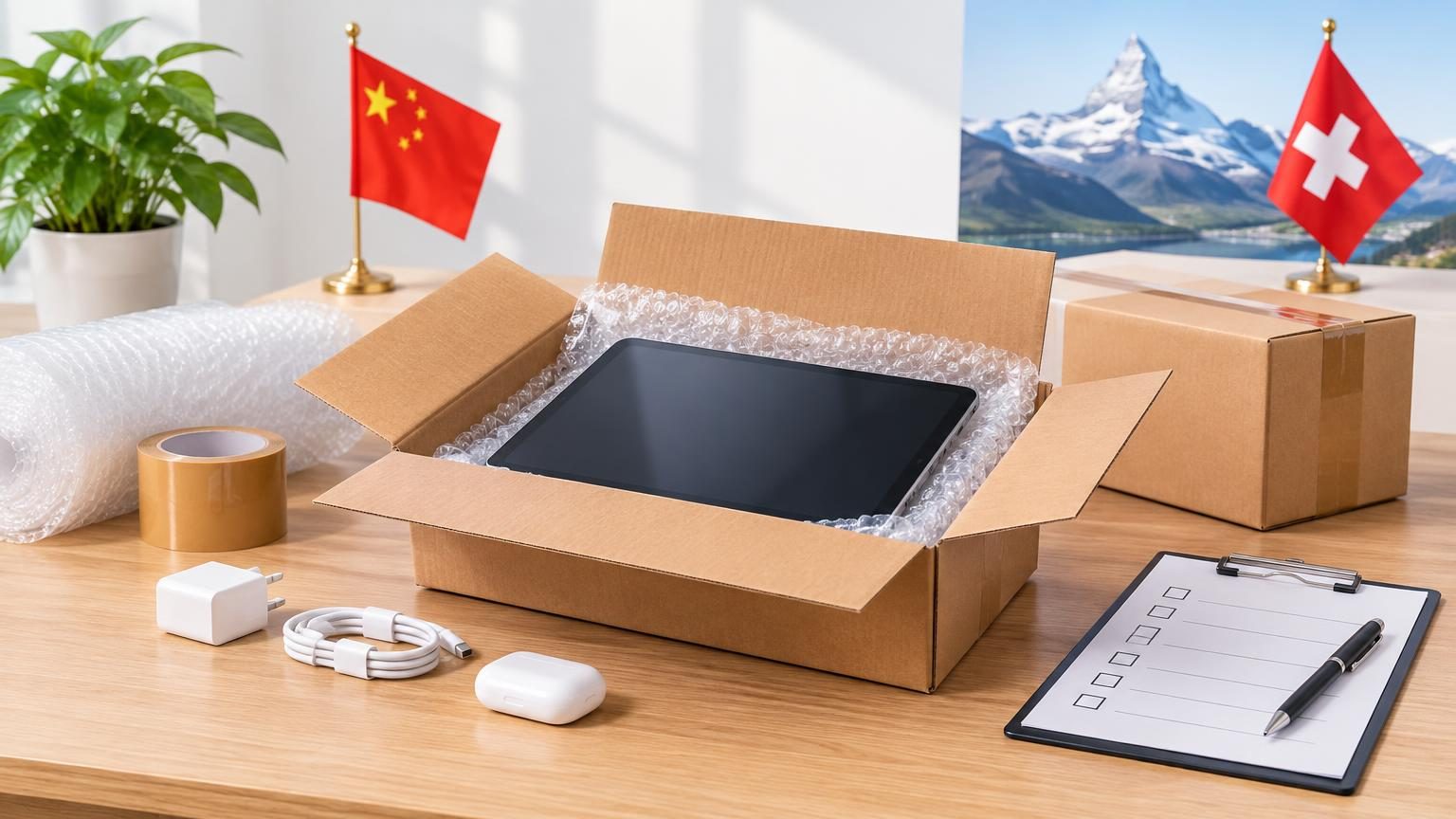
Prepare a parcel of electronics for Switzerland by checking battery acceptance, comparing quotes, protecting the device, and getting the customs paperwork ready.
A phone with its battery installed and the same phone packed alongside a spare battery may need different shipping arrangements. That distinction matters when you’re shipping electronics from China to Switzerland: a quote based on ‘one box of electronics’ may not reflect what the parcel actually contains. Before ordering a device for delivery to a Chinese forwarding address or booking a pickup, send the forwarder the model, battery details, and Swiss postcode.
The aim is to find a service that accepts your exact parcel, then compare charges and delivery estimates on the same basis. Here’s how to prepare a shipment, whether it’s a tablet from a Chinese marketplace, a laptop you’re sending to family, or an order for a Swiss customer.
Start with the device and its battery
Make a packing list before you look at shipping options. Write down the make and model, whether the item is new, used, or refurbished, and what will go into the carton with it. A charger and a loose rechargeable battery are different items for transport purposes. List them separately, even if the seller included them in the same retail box.
For a battery-powered device, note whether the battery is installed in the equipment, packed alongside it, or shipped on its own. Provide the battery chemistry and the watt-hour rating shown on the label or in the manufacturer’s specifications, if applicable. If a marketplace listing simply says ‘rechargeable’, ask the seller for a clear photo of the label or a manufacturer’s specification sheet for the exact model. That’s more useful than a product photo that only shows the outside of the device.
A laptop with its internal battery, a camera with a removable battery in the box, and a power bank can fall under different transport conditions. A power bank is typically treated as a battery for transport rather than as a charger without a battery. Small electronics can also contain batteries that aren’t obvious from the listing, such as a tracker with a lithium button cell. Tell the forwarder what’s fitted, not just what the device is called.
Condition matters as well. A used device with an intact battery is a different proposition from one with a swollen, leaking, damaged, or recalled battery. If you suspect a battery problem, pause the shipment and seek instructions from the manufacturer or a qualified local battery-handling service. Ask the carrier or forwarder whether it needs product documentation and what its current acceptance conditions are. The International Air Transport Association provides background on air transport rules, while the operator can confirm what it accepts on the proposed route.
Choose a shipping option after the contents are confirmed
For a compact device, ask about international express first. It gives you a useful benchmark when comparing the quote, tracking arrangements, and expected delivery schedule. DHL, FedEx, and UPS are examples of carriers you may encounter while comparing options. Treat the carrier name as a starting point: ask which service is being quoted and whether it accepts the battery configuration from the Chinese origin to the Swiss destination postcode.
For larger cartons or several devices, ask whether an air freight quote makes sense. Check what the quote covers between collection and delivery. An airport-to-airport quote is a different purchase from a quote that includes transport to a home in Lausanne or a business in Basel. Ask who handles export and import paperwork, where the handoffs happen, and how the parcel or consignment would reach the recipient after arrival.
Sea freight may be worth discussing for a larger commercial consignment when the delivery schedule is flexible. It’s a less useful starting point for a single compact parcel: collection, terminal handling, and inland delivery can matter as much as the main transport leg when comparing the total cost. Ask for a quote through to the Swiss postcode so that you can compare it with an air option on similar terms. Battery acceptance and current routing still need confirmation.
If you’re ordering from several Chinese shops, consolidation may help you manage the inbound parcels and the final carton. But the decision should come after reviewing the contents. Combining a keyboard, a laptop, and a power bank could change the services available for the whole box. Ask the forwarder to compare the proposed carton with separate shipments if acceptance, packaging, or chargeable weight makes the combined arrangement less suitable.
Compare quotes using the packed size and the Swiss postcode
Request quotes based on the same origin, destination, device list, battery details, and packing assumptions. Give the forwarder the final outer carton dimensions and packed weight if you have them. If the parcel still needs repacking, mark the dimensions as provisional and ask for an updated quote once the box has been measured. A seller’s listing may show the product weight or the size of its retail packaging rather than the size of the shipment.
Carriers may use dimensional weight, which accounts for how much room the carton takes up, when calculating the chargeable weight. A lightweight gaming headset, for example, can take up more space than its actual weight suggests once it’s in a protective carton. Ask how the quoted service calculates chargeable weight and whether the price will be reviewed after measurement. A snug outer box with adequate cushioning is a better target than either a roomy carton stuffed with filler or a tight box with little protection around the device.
Read the quote for scope, not just for the transport charge. Check whether it includes collection in China, export handling, any applicable battery-related handling, import clearance services, and delivery to the Swiss address. Ask which costs are payable at booking, which may be billed separately, and who will be asked to pay them. Customs charges and a carrier’s clearance or disbursement fees are different things; knowing how each is handled helps the sender and the recipient plan for delivery.
For timing, ask where the current route estimate starts and ends. Collection, warehouse intake, packing, and document review may happen before the transport leg begins. Import clearance and final delivery can affect the arrival date after the parcel reaches Switzerland. If you’re shipping a replacement laptop for someone who needs it for work, ask when the parcel would be ready for dispatch as well as how the carrier estimates delivery from that point.
Prepare the Swiss customs paperwork before dispatch
Use an accurate goods description and value, and follow Switzerland’s current official customs requirements. A description such as ‘used laptop computer with installed rechargeable lithium-ion battery’ gives more useful information than ‘electronics’, provided it matches the item. List accessories separately where relevant, and make sure the shipment details agree with the invoice and any supporting records. Check the current requirements with Switzerland’s Federal Office for Customs and Border Security and ask the carrier what it needs to process the parcel.
For a recent purchase, keep the seller invoice or order confirmation and payment record ready. If a parcel combines purchases from different shops, keep the records for each item and tell the forwarder which items are in the final carton. For used personal electronics, gifts, repairs, or returns, tell the carrier the purpose of the shipment and check the official guidance on documenting the value and transaction. If you no longer have a receipt for an older device, ask what evidence is appropriate for its condition and shipment purpose.
If you’re selling through your own online shop or a marketplace, compare the shipment paperwork with the customer’s order record before dispatch. The device model, accessories, item quantities, and value should be consistent. If the platform has collected a tax at checkout, keep the transaction record and ask the carrier how that information should be supplied for the shipment. Check current official requirements for the product and transaction rather than relying on settings from another market.
Import VAT and other applicable charges depend on the shipment and current rules. Ask the carrier how it collects any charges it handles and who receives the payment request. Confirm the document format and whether signed or printed copies are needed for the service you’re using. If you’re comparing quotes for a sale, agree with the buyer in advance who is expected to pay which charges. It’s easier to sort that out before dispatch than after the recipient gets a payment notice.
Pack for sorting, handling, and delivery
A retail box is designed around the product, but it may need an outer shipping carton to protect corners, screens, and controls during parcel handling. Use a sturdy carton that fits the device and its cushioning. Pay particular attention to laptop hinges, monitor panels, and camera lenses. Keep plugs, chargers, and other hard accessories from moving against a screen or rubbing against the device. After arranging the contents, check that the device stays in place when the carton is moved gently.
For battery-powered equipment, follow the operator’s current packing instructions. These may address how to prevent accidental activation, protect battery terminals, isolate permitted spare batteries, and apply any required marks or labels. Ask who will prepare the final package and verify its markings, especially if a seller is shipping to a forwarding address in retail packaging. If the warehouse will repack the contents, send the item list and battery information before it closes the carton.
Photograph the device condition, model label, and packing before the box is sealed. For a sold or repaired device, keeping a serial number in your own records may also help you identify the unit if there’s a query. If loss or damage would be costly, ask the quoted provider about any protection available for that item, the applicable exclusions, and the evidence needed for a claim. Keep the packaging and shipment records handy if the recipient reports visible damage, and check the carrier’s current reporting procedure.
Decide whether consolidation suits the order
Consolidation can be useful when separate Chinese orders are going to the same Swiss address. Think about how the items fit together, not just how many parcels could become one. A cable and a lightweight case may pack neatly with a device. A heavy accessory in the same carton as a monitor calls for more separation and protection, and a separate removable battery may affect the available transport options.
Before placing orders, ask what information the forwarding provider needs to identify each inbound parcel and whether it can confirm the final carton dimensions and contents before booking. Keep the Chinese domestic tracking references and match them to the order records. This makes it easier to spot a missing accessory or an unexpected battery before the international shipment is prepared. If the seller substitutes a model, update the forwarder before accepting the quote: a visually similar device may have different battery specifications.
Also consider which items the recipient needs first. If a work device is ready to ship but a bulky accessory has a later dispatch date, waiting for consolidation may not suit the delivery schedule. Compare the current separate and combined quotes, along with the expected dispatch dates and packing plans. Consolidation is a choice about cost, timing, and handling, not just carton count.
Check the Swiss address and plan for arrival
Use the recipient’s name, street and house number, postcode, and locality as they appear in the recipient’s Swiss address. For an office or shared building, add the company or department name where it helps the carrier find the right door. Provide a phone number and email address the recipient checks, with their permission. The carrier may use those details for a document request, an import payment notice, or delivery instructions.
Ask which tracking reference to use and whether a local delivery partner may issue another one. An unchanged tracking status can reflect a handoff or a processing stage. If the shipment passes a milestone in the current estimate or the status asks for action, contact the booking provider with the tracking reference and have the invoice and item list available. If a payment request arrives and the recipient is unsure whether it’s genuine, they can check it through the carrier’s official tracking or contact channel.
For personal purchases, a quick compatibility check is worthwhile before the order leaves China. Confirm whether the charger suits Swiss sockets and the local power supply, and check any regional product features, language settings, or warranty arrangements that matter to the recipient. If you’re importing products for resale, check the Swiss product requirements that apply to the device category as well as the customs requirements. Carrier acceptance and product compliance are separate checks.
FAQ
Can I ship a laptop with its battery installed from China to Switzerland?
It may be possible on a service that accepts the device’s battery configuration and condition. Provide the model, battery specifications, and Swiss postcode, and ask the provider to confirm the current route and packing requirements. If the box also contains a spare battery, mention it when requesting the quote.
How much does it cost to ship electronics from China to Switzerland?
The quote depends on the packed weight and dimensions, the origin and destination addresses, the battery configuration, and the services included. Request a current quote using the final carton details and check which handling, clearance, and delivery charges it covers. Ask how applicable import charges are handled and who will be billed.
How long does delivery to Switzerland take?
Ask for a current estimate for the specific service and postcode. The schedule can depend on battery review, collection, dispatch, transport connections, customs clearance, and final delivery. Confirm whether the estimate starts at pickup, warehouse intake, or dispatch and whether it covers delivery to the address.
What paperwork should I prepare for a used phone?
Prepare an accurate description, the phone’s value, its condition, and the reason for shipping. Keep any relevant purchase or valuation records available and tell the carrier whether the battery is installed. Follow current Swiss customs requirements and confirm the documents the carrier needs for that transaction.
Can I put a power bank in the same carton as a tablet?
Ask the carrier to assess the two items together. The tablet with its battery installed and the separate power bank may be treated differently for transport. Share the specifications for both and ask whether the service can accept the proposed package or whether separate arrangements would be suitable.
Get the parcel assessed before you book
Send the device list, battery details, packed weight and dimensions, China pickup or forwarding location, and Swiss postcode when requesting a quote. Mention whether you need consolidation or delivery to the recipient’s address, and ask what the estimate includes. You can review HuaBangExpress shipping and forwarding services or email [email protected] to confirm current availability and request a quote for your parcel.
Related Articles
Shipping a Phone From China to Switzerland? Check the Battery First
November 22, 2026
PC Parts from China to Switzerland: Check Model Labels Before Forwarding
November 21, 2026
Find the Return Tracking Number for a HuaBang Warehouse Parcel
November 20, 2026
Correct Product Details in a Pending HuaBang Parcel Forecast
November 19, 2026